





How to Write AI Prompts: A Simple Guide for Beginners
When you ever typed something into an AI tool and found yourself thinking, Wow, that answer was not what I wanted you are not alone. It is often not the AI that is the problem, but the prompt.
Comprehending how to compose AI prompts is comparable to learning how to communicate with an intelligent assistant of unbelievable intelligence. Clear instructions lead to clear outcomes. The AI will need to make a guess with a vague prompt, and the responses are arbitrary or generic.
This not-so-complicated guide will give you the foundations of prompt engineering, examples of it, and some immediate tips you can apply to the tools, such as ChatGPT and other AI assistants, in the long run.
What Is a Prompt (and Why Is That so Important)?
A prompt is nothing more than what you write or speak to an artificial intelligence tool.
It can be:
- A question
- A command
- A description
- A combination of all three
For example:
Say to my boss I am going to be out of work tomorrow, write a business e-mail.
Get me to understand the fundamentals of budgeting as if I was new to the personal finance world.
The AI takes your prompt as a guide. Provided that there is an effective organization of those instructions, you will have a powerful response. When they are imprecise you will find it half a wrench trying to make sense of them… half.
The process of learning to write AI prompts is not technical. It is all about learning how to provide instructions.
Understand Artificial Intelligence with Your Commands
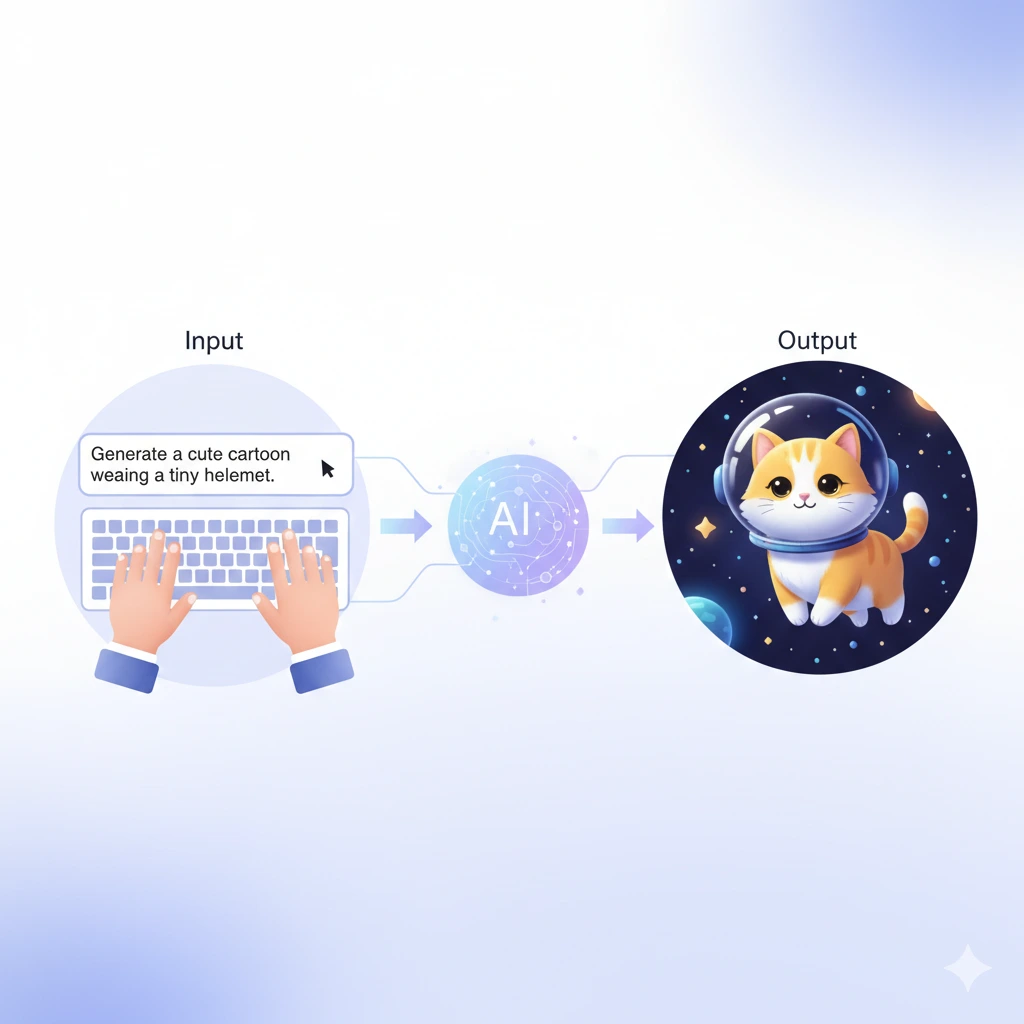
One does not need to understand the math behind AI, yet a basic mental model is helpful:
The AI has been exposed to a vast quantity of text.
It examines your prompt, and it attempts to anticipate what response somebody would give next, which would be helpful.
It makes its response out of patterns it learned from all that text.
The AI does not actually know you in a friendly way that a human friend does. It has no idea what your life is like, what you want to achieve, or what kind of personality you possess, unless you tell it.
This is why the most useful input to ChatGPT and other similar tools is contextual:
- Who you are
- What you’re trying to do
- Who the result is for
Limitations (length, tone, format)
The AI is intelligent, though it requires you to guide the discussion.
The 4-Part Simple Formula of Writing AI Prompts.
This is a simple formula to use in most tasks. Consider it as a basic prompt engineering to a regular user.
Who you are
- Goal / task
- Context / details
- Format / style / constraints
Let’s break it down.
1. Who You Are
This assists the AI to personalize the response.
Examples:
- I am a student studying in the United States.
- I am an online store owner who is a small business owner.
- I am a novice who is learning on investing.
2. Goal / Task
Clearly say what you need.
Examples:
- I would like to have assistance in composing an email to a customer.
- I would like to have a straight forward explanation of this subject.
- I require suggestions on what to post on social media.
3. Context / Details
Give the AI the important information it requires to perform a good job.
Examples:
- The 3 day delay in the order of the customer.
- It is about the subject of personal finance, compound interest.
- My target audience is novices and people who have a fear of visiting a gym.
4. Format / Style / Constraints
Tell the AI what the output should look like.
Examples:
- “Keep it under 150 words.”
- “Use a friendly but professional tone.”
- “Give me a bullet point list, not a long paragraph.”
Put it together:
“I am a small business owner in the United States. I need to write an email to a customer whose order is delayed by 3 days. Please write a friendly but professional email that apologizes for the delay, gives a new estimated delivery date, and offers a small discount on their next purchase. Keep it under 150 words.”
That’s a strong prompt. It gives the AI everything it needs.
Prompt Patterns for Common Tasks

Now let’s turn the formula into reusable patterns for daily life.
1. Writing and Emails
Use this pattern when you want the AI to write something from scratch:
- Who you are
- Who the message is for
- Why you’re writing
- Tone and length
Example pattern:
“I am a [role]. Write a [short/medium] [type of text] to [audience] about [topic]. The tone should be [friendly / professional / casual]. Keep it around [length].”
This works for:
- Work emails
- Intro messages
- Simple letters
- Basic documents
2. Ideas and Brainstorming
When you want ideas, be clear about the topic and audience.
Example pattern:
“I am a [role]. Give me [number] ideas for [type of content] about [topic]. My audience is [who they are]. Make the ideas [style: fun, serious, simple, advanced].”
This works for:
- Blog ideas
- YouTube video topics
- Social media posts
- Product or service ideas
3. Learning and Studying
AI is great at teaching, if you tell it your level.
Example pattern:
“I am a [student/learner type] and I’m struggling with [topic]. Explain it in simple terms like I am [age/level]. Then give me [number] examples and [number] practice questions.”
This works for:
- School subjects
- New skills (coding, finance, business basics)
- Understanding news or complex concepts
4. Planning and Productivity
Use AI like a planning assistant.
Example pattern:
“I have these tasks: [list tasks]. I can spend about [time] per day. Create a simple [daily/weekly] plan that organizes these tasks by priority. Show it as [bullet list / schedule].”
This works for:
- Weekly planning
- Study schedules
- Project planning
5. Editing and Rewriting
You don’t always need the AI to write from scratch. Some of the best prompts for ChatGPT involve improving what you already wrote.
Example pattern:
“Here is my text: [paste text]. Improve clarity and fix grammar while keeping my voice. Make it sound [tone: more professional / friendlier / simpler]. Do not add new ideas.”
This works for:
- Emails
- Blog posts
- Social media captions
- Reports and documents
Before-and-After Prompt Examples
Let’s look at some real comparisons so you can see how how to write AI prompts changes the results.
Example 1: Email to a Manager
Weak prompt:
- “Write an email to my manager about a meeting.”
Stronger prompt:
- “I work in customer support. Write a polite, professional email to my manager asking for a 20-minute meeting next week to discuss my workload and possible ways to improve our response times. Keep it under 130 words.”
Why it’s better:
- Includes your role
- Includes the purpose of the meeting
- Includes tone and length
Example 2: Studying a Difficult Topic
Weak prompt:
- “Explain photosynthesis.”
Stronger prompt:
- “I am a high school student in the United States. Explain photosynthesis in simple terms using short paragraphs. Then give me 5 key points to remember and 3 practice questions I can answer to check my understanding.”
Why it’s better:
- Specifies level
- Requests clear format
- Asks for practice questions
Example 3: Social Media Ideas
Weak prompt:
- “Give me Instagram ideas.”
Stronger prompt:
- “I am a beginner fitness coach. Give me 15 Instagram post ideas about simple home workouts for busy adults. My audience is people in their 20s–40s who work full-time and feel they have no time to exercise. Make the ideas practical and encouraging.”
Why it’s better:
- Defines your role
- Defines your audience
- Defines topic and style
Use these before/after patterns as models when you write your own prompts.
Prompt Engineering Basics: Extra Power Moves
Once you’re comfortable, you can add a few extra prompt engineering basics to improve results even more.
1. Assign a Role to the AI
You can tell the AI what role to “play” for a better answer.
Examples:
- “You are a friendly English tutor.”
- “Act as an experienced marketing consultant.”
- “You are a patient math teacher helping a beginner.”
This often leads to more focused and helpful responses.
2. Ask for Step-by-Step Answers
If a task or explanation is complex, ask for steps.
Examples:
- “Explain this in step-by-step form.”
- “Give me a numbered list of steps I should follow.”
This makes the response easier to follow and implement.
3. Ask for Multiple Options
Instead of one answer, ask for several options.
Examples:
- “Give me 5 versions of this email subject line.”
- “Offer 3 different ways to explain this concept, from simplest to more detailed.”
This lets you pick and combine the best parts.
4. Refine with Follow-Up Prompts
Don’t stop after the first answer. Some of the best prompts for ChatGPT are follow-ups like:
- “Make this shorter.”
- “Use simpler language.”
- “Change the tone to be more casual.”
- “Add one more example.”
Think of prompt writing as a conversation, not a one-time command.
Safety, Boundaries, and Responsible Prompts
Writing good prompts isn’t only about better results, it’s also about using AI safely and responsibly.
Keep these guidelines in mind:
- Don’t request harmful, illegal, or unsafe advice
- Avoid sharing sensitive personal details
- Do not use AI to manipulate, harass, or deceive people
- Follow your school or workplace policies if they have AI rules
Good prompts stay within healthy boundaries:
- Education
- Productivity
- Creativity
- Clear, honest communication
A Simple 10-Minute Practice Routine
Here’s a quick routine to build your prompt skills daily.
- Choose one real task
- An email, a short explanation, a simple plan, or content idea.
- Write a first draft prompt
- Don’t worry if it’s not perfect.
- Improve it with the 4-part formula
- Add who you are, context, and format.
- Send it to the AI and review the result
- Notice what you like and what feels off.
- Write one follow-up prompt
- Ask the AI to tweak length, tone, or format.
Over a week or two, you’ll see a big difference in the quality of answers you get.
Key Takeaways
- Learning how to write AI prompts is more about clear communication than technical skills.
- Strong prompts usually include four parts: who you are, your goal, relevant context, and the format or style you want.
- Prompt patterns make it easier to get good results for writing, ideas, studying, planning, and editing.
- Before-and-after examples show that adding details, tone, and constraints dramatically improves AI responses.
- You can go beyond the basics with role assignments, step-by-step requests, multiple options, and follow-up prompts.
FAQs
What is an AI prompt in simple terms?
An AI prompt is whatever you type or say to an AI tool to tell it what you want. It can be a question, instruction, or description. The AI uses that prompt as its “instructions” for what to do next.
Why are my AI results often generic or not helpful?
Most of the time, the prompt is too short or vague. If you don’t give details about who you are, what you want, and how you want it, the AI has to guess. Clear, detailed prompts lead to more specific and useful answers.
Do I need to learn advanced “prompt engineering” to use AI well?
No. The basics, like giving context, specifying tone and format, and using follow-up questions, are enough for most everyday tasks. Advanced techniques can help, but they’re not required to get great results.
How long should a good AI prompt be?
There’s no fixed length, but it should be long enough to include key details without becoming confusing. Many effective prompts are just 2–5 sentences that clearly explain the task, context, and desired output.
Can I reuse the same prompts?
Yes, and you should. Reusable prompt patterns for emails, ideas, summaries, and explanations can save you a lot of time. You can tweak them slightly for each new situation.
What if the AI still doesn’t understand my prompt?
Try breaking your request into smaller steps. First, ask it to clarify what it understood. Then, correct or add details. You can also say, “You misunderstood. Here’s what I actually want…” and restate your goal clearly.
Is it okay to use AI prompts for school or work?
AI can be very helpful for understanding topics, organizing ideas, and improving writing. Just make sure you follow your school or workplace rules and don’t present AI-generated work as entirely your own if that’s not allowed.